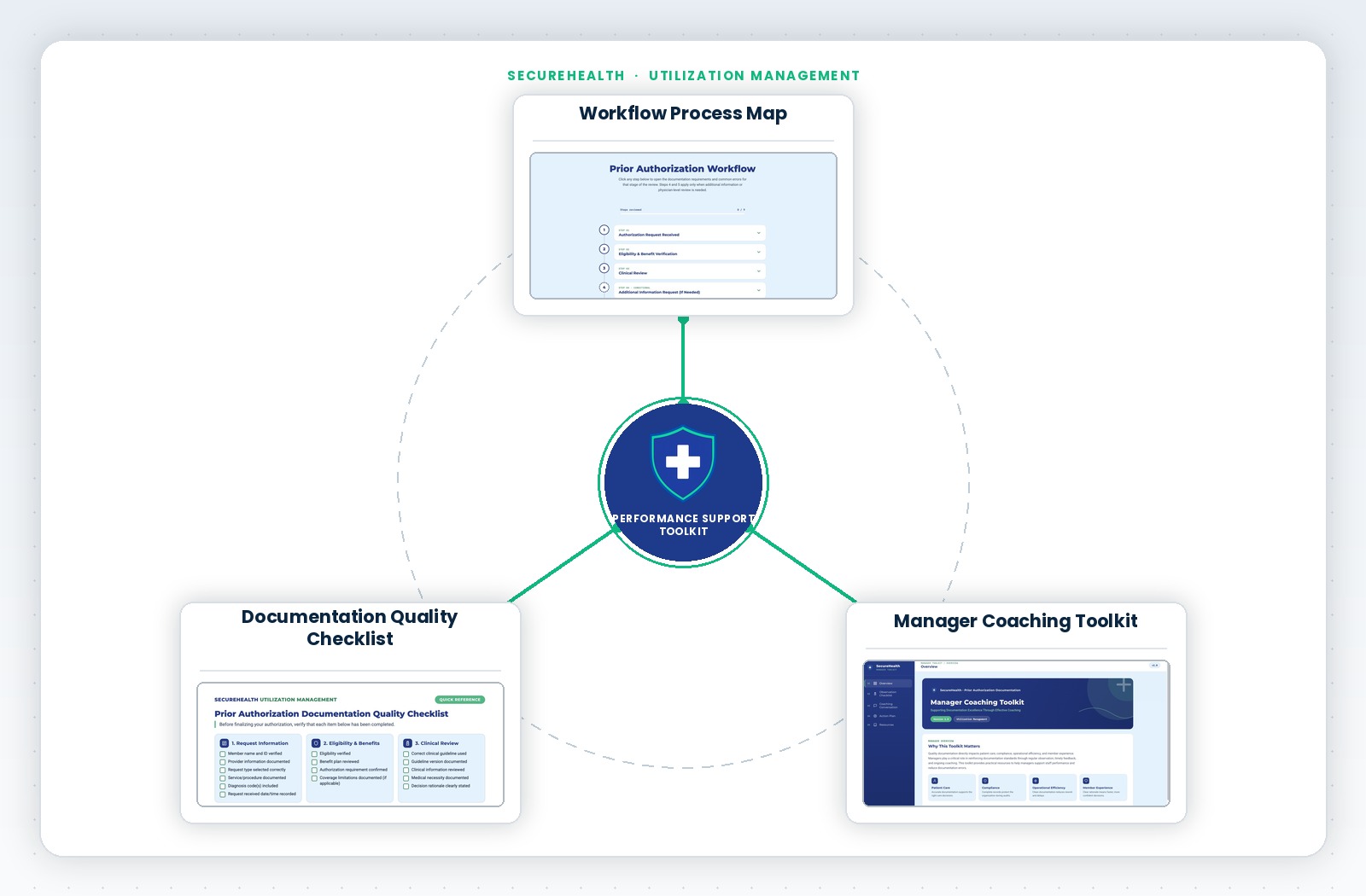
Performance Support Toolkit for Healthcare Utilization Management
A SecureHealth Insurance case study, the fictional health insurance company also featured in the PHI Under Attack project, showcases how instructional design can extend beyond course development to solve real workplace performance challenges. Using Human Performance Improvement (HPI) principles, I created an integrated toolkit of performance support resources to help employees apply documentation standards accurately within their daily workflow.
SecureHealth utilization management employees who complete prior authorization documentation, and the supervisors who coach them.
Figma, Claude AI, HTML, CSS, JavaScript
Performance consulting, workflow analysis, root cause analysis, performance support design, UX design, job aid development, coaching toolkit design
Quality assurance audits at the SecureHealth Insurance company have identified recurring documentation errors during the prior authorization review process. These inconsistencies resulted in rework, delayed determinations, and increased compliance risk. While employees understood the documentation requirements, they struggled to apply them consistently within a fast-paced, complex workflow.
Rather than recommending another traditional eLearning course, I approached the problem through a performance consulting lens. The analysis suggested that employees needed timely guidance and workflow support, not additional information.
Using Human Performance Improvement (HPI) principles, I designed a performance support toolkit that provides employees with the right information at the moment they need it. Instead of relying on a single training event, the solution integrates learning resources directly into the workflow to improve accuracy, confidence, and efficiency.
The project demonstrates how instructional design can extend beyond course development to improve on-the-job performance.
A process map that shows the entire prior authorization workflow and an interactive guide that helps employees perform a specific task. Employees can see exactly where they are in the process and drill into the specific documentation requirements, common documentation errors, and escalation paths for that step, reducing cognitive load and improving documentation consistency.

A one-page checklist summarizing documentation requirements, common errors, and best practices. Designed for rapid reference while employees complete documentation, so they can quickly self-verify that quality standards have been met before closing a case.

A structured coaching guide that helps supervisors reinforce documentation standards through observation checklists, coaching conversations, and follow-up planning.

Although this is a portfolio concept project, the solution is designed to support measurable business outcomes, including:
Traditional training often assumes that performance problems can be solved with more instruction. This project demonstrates a different approach, one that combines instructional design, performance consulting, and workflow support to help employees succeed in the moment of need.
By designing a complete performance support toolkit instead of a standalone course, this project illustrates how learning experiences can improve both employee performance and business outcomes in a healthcare insurance environment.