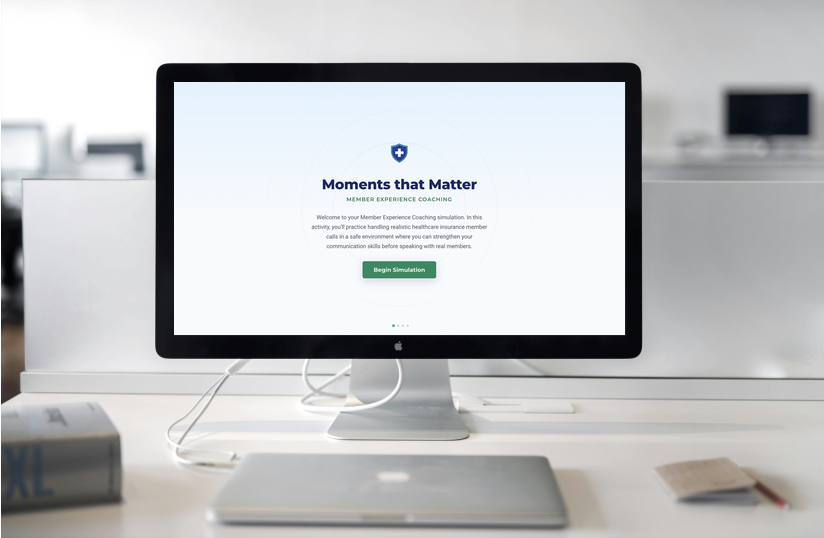
Navigating Difficult Conversations
An AI powered member experience coaching that helps healthcare insurance customer service representatives practice empathy, de-escalation, and clear communication during emotionally charged member interactions.
This is a portfolio concept project built to explore how AI can power realistic, judgment-based practice, designed as a working prototype rather than a deployed corporate training tool.
Healthcare insurance customer service representatives who handle member calls involving claim denials and other difficult conversations.
Claude AI (application development), HTML, CSS, JavaScript, AI-assisted prototyping, responsive web design
Performance analysis, learning strategy, scenario design, conversation scripting, storyboarding, user interface design, AI interaction design, assessment strategy, visual design direction, HTML/CSS/JavaScript application design
Healthcare insurance customer service representatives frequently handle calls from members who are frustrated, confused, or upset after receiving an unexpected claim denial. While representatives often understand coverage policies, many struggle with the communication skills needed to navigate difficult conversations.
Common performance challenges include:
Traditional eLearning often teaches communication techniques through static content or multiple-choice questions, but it rarely gives learners an opportunity to practice responding in realistic conversations and receiving meaningful feedback.
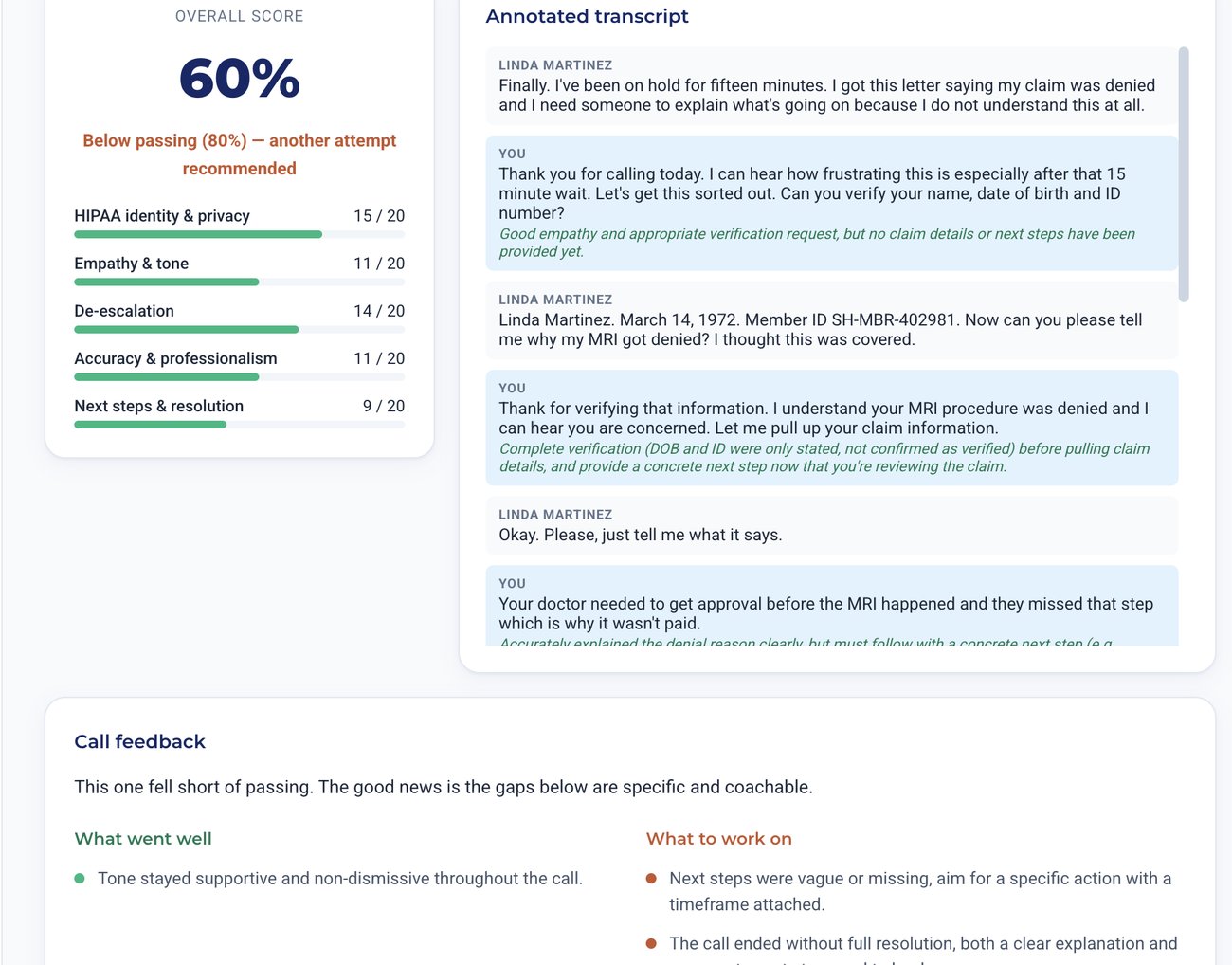
I designed an AI-powered conversation coaching simulation that allows learners to practice a realistic member interaction in a safe environment. Learners assume the role of a healthcare insurance customer service representative assisting members whose claims have been denied. Throughout the simulation, learners type responses to the member, who reacts dynamically based on the learner's communication choices, and the system coaches them on key communication behaviors as the conversation unfolds.
"Finally. I've been on hold for fifteen minutes. I got this letter saying my claim was denied and I need someone to explain what's going on because I do not understand this at all."
"Thank you for calling today. I can hear how frustrating this is especially after that 15 minute wait. Let's get this sorted out. Can you verify your name, date of birth and ID number?"
"Good empathy and appropriate verification request, but no claim details or next steps have been provided yet."
Rather than simply testing knowledge, the simulation develops practical communication skills through guided practice and immediate feedback.
Here's how that scenario-based approach came together, from the design strategy behind it to the technology that powers it.
Key design strategies include:
To create a more authentic learning experience, I designed the simulation as an interactive web application rather than a traditional slide-based course. Key features include:
The goal was to create an experience that feels more like practicing with a virtual customer than completing an online course.
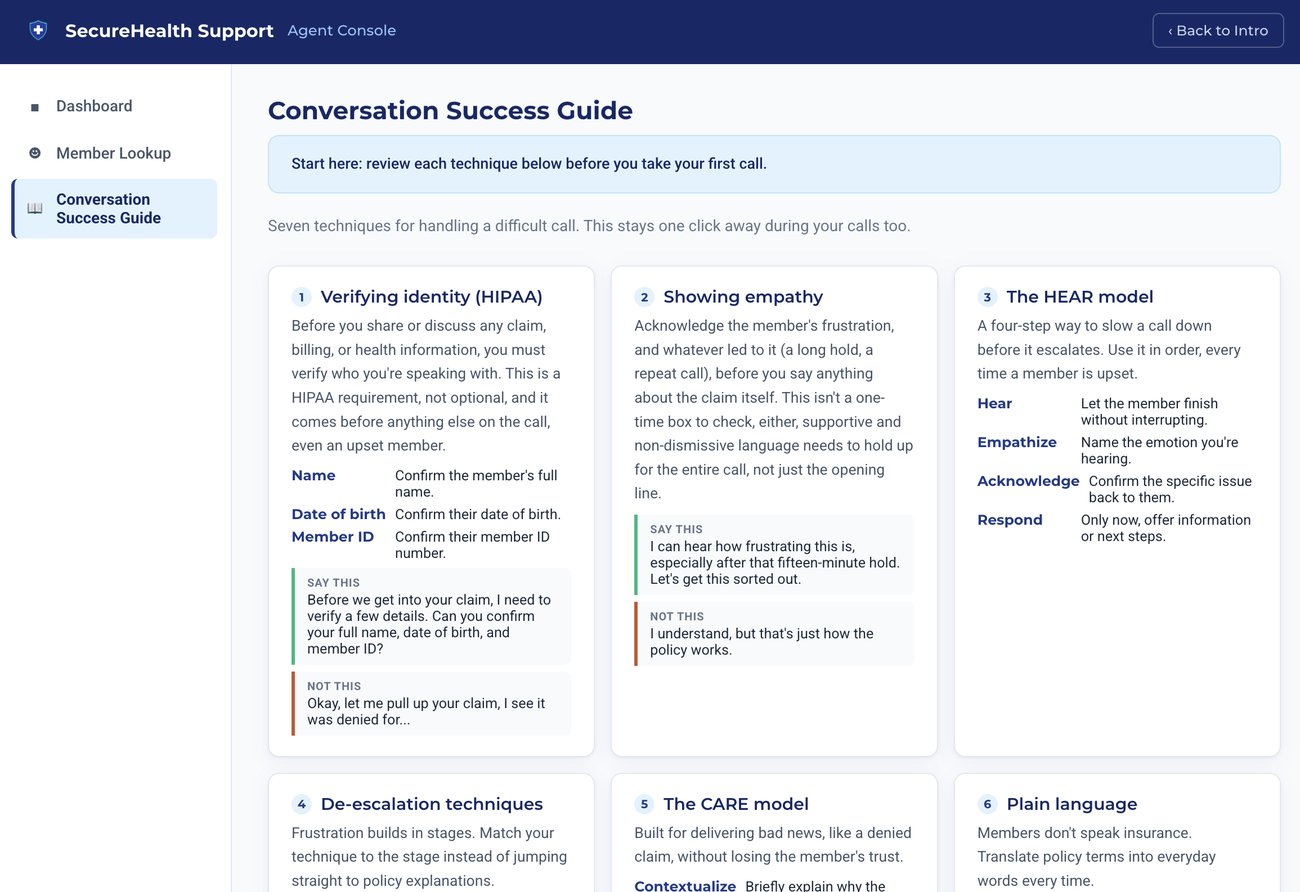
Because communication skills improve with practice and support, the simulation includes an embedded Conversation Success Guide that learners can access at any time. It covers empathy techniques, de-escalation strategies, and plain-language communication tips, including a framework for delivering difficult news using the CARE model, along with compliance reminders and a quick conversation checklist. This transforms the resource into both a learning aid and a practical job aid learners can lean on in the moment, not just during training.
Instead of using a traditional authoring tool, I designed this project as a custom HTML application, built with HTML, CSS, and JavaScript, using Claude AI for application development and AI-assisted prototyping, to explore how AI can support modern workplace learning. This approach allowed me to focus on creating a more flexible, software-like learning experience while demonstrating how AI can accelerate instructional design workflows.
As a concept prototype, this project hasn't been deployed with a live team, but it's designed to move the needle on the metrics that matter most in a call center environment: faster de-escalation, fewer compliance flags, fewer emotionally charged calls, and reps who feel more confident, not just more informed, walking into a difficult conversation.
This project reinforced that effective learning experiences extend beyond choosing the right authoring tool. By combining instructional design principles with AI-assisted development, I was able to prototype a realistic conversation simulation that emphasizes practice, feedback, and performance improvement.
It also deepened my understanding of how AI can support, not replace, sound instructional design by enabling more personalized, interactive, and authentic learning experiences.
Explore the simulation and see how it guides reps through real conversation decision points.
Experience the Project